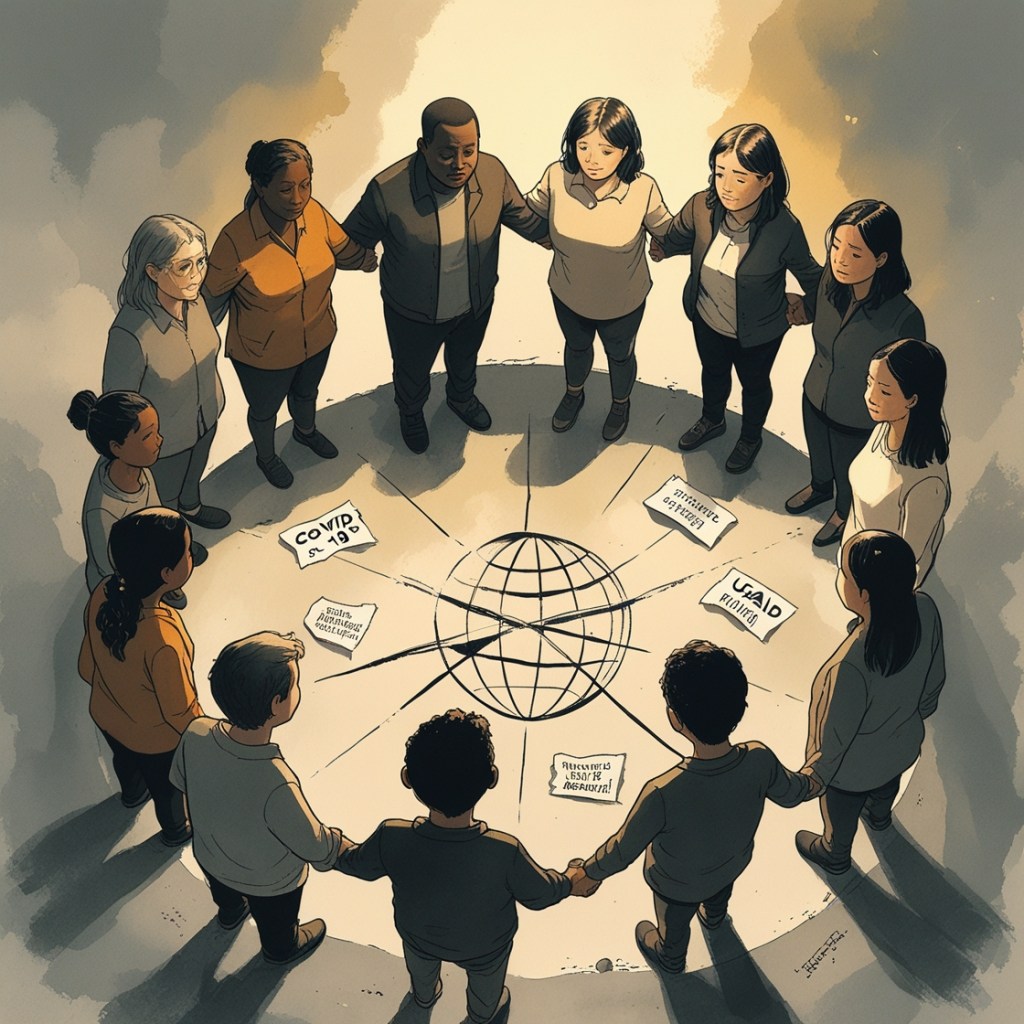
We often walk into the development sector filled with idealism, armed with a sense of purpose, and the belief that systems, if designed well, will hold firm. But every so often, life throws a disruption so vast and so sudden that it cuts through institutional layers and exposes the foundation beneath. For those of us in public health, the COVID-19 pandemic and the recent withdrawal of USAID funding from India were just that. They weren’t merely operational setbacks — they were equalising moments. They stripped away structures, paused processes, and reminded us, often uncomfortably, of our shared vulnerability. And amid the chaos, one sentiment slowly emerged stronger than ever: gratitude.
I still remember the first few weeks of the pandemic. Cities were locked down, ambulances wailed in the background, and health systems came under enormous strain. Urban health centres in Delhi struggled to maintain services; rural sub-centres in Bihar were barely operational. Community outreach came to a halt. Routine Immunization (RI) sessions, antenatal care check-ups, and adolescent health activities were suspended overnight. In Karnataka’s slums, girls who once gathered in small groups to discuss menstruation and mental health under the RKSK program were now confined indoors, many under increased risk of early marriage or violence. In Odisha, mobile health vans once used for tuberculosis outreach were hastily repurposed for COVID surveillance. In Madhya Pradesh, the Anganwadi centres sat deserted with no `kilkari’ of the children and malnutrition were no longer being tracked. Even the most robust flagship initiatives such as PM-Poshan Abhiyaan, NHM outreach activities, and community-level ASHA home visits had to pause or shift focus entirely.
Yet, in the absence of structure, something else began to emerge — solidarity. Despite immense fear and lack of clarity, frontline health workers began stepping in. I recall an ANM in rural Maharashtra who walked for hours each day to educate a tribal village about COVID precautions and vaccination. In Jharkhand, an NGO pivoted its entire digital literacy program into a telephonic COVID helpline for women stuck in abusive homes. Large or small, urban or rural, everyone in the sector was touched. Funding size didn’t matter. Organizational reach didn’t matter. Everyone had to improvise, adapt, and support one another in real time. COVID-19 reminded us of what we often forget in meetings and reports — that health systems are ultimately made up of people.
Just as the world began to stabilize post-pandemic, another significant disruption swept across the sector. USAID, a major donor that had played a critical role in public health programs in India and globally for decades, began its phased withdrawal. On paper, it was a planned transition. In reality, it sent shockwaves across programs that had become lifelines for many marginalized communities. Programs started to wind down. Long-standing partners — from national technical agencies to small grassroots NGOs — found themselves grappling with reduced budgets and no clear contingency plans.
The impact wasn’t just administrative. It was deeply human. I remember reading to a transgender peer educator from Tamil Nadu who had built trust and networks in her community over more than a decade. “We are not just losing funding. We are losing our seat at the table.” Programs that had provided health information, psychosocial support, and legal aid alongside clinical services began to shrink. Many community-based organizations, particularly those outside metro cities, lacked the resources or capacity to sustain their work beyond donor cycles. Even as some parts of the program were absorbed by government systems, the community ownership, flexibility, and person-centred approach that donor-supported projects had nurtured began to fade.
What sustains us when support fades
This too became an equalizer. Whether you were leading a ₹50 crore project or managing a two-person field office in a remote district, the uncertainty felt the same. Funding pipelines dried up. Field staff began to leave. Transition plans, though well-intentioned, struggled to capture the nuances of community-led health delivery. In both the pandemic and the donor exit, the same questions emerged: How do we sustain what matters? Who do we turn to when the system recedes? What remains when structure dissolves?
Through both these disruptions, I found myself returning to the same lesson again and again: gratitude. Not the soft kind we add at the end of speeches, but a deeper, more resilient kind. I’m grateful to the ASHAs in Mysuru who resumed home visits long before official orders were issued — simply because they felt responsible. To the adolescent girls in Uttar Pradesh who began making reusable sanitary pads and distributing them locally when supplies ran out. To the SHGs in Chhattisgarh who took over malnutrition screening using only MUAC tapes and a borrowed mobile phone for data logging. And yes, to the donor officials who, even as they announced exits, remained accessible and supportive during difficult conversations.
Gratitude, in this sense, becomes more than emotion. It becomes a strategy — to remain grounded, to build trust, to endure. It reminds us that even in breakdowns, we are not powerless. That our capacity to care, connect, and co-create is what ultimately sustains health systems. These equalising moments, painful as they are, force us to look beyond funding cycles and logframes. They urge us to reimagine resilience — not as a technical output, but as a human outcome.
The disruptions won’t end here. Whether it is climate-linked disease outbreaks, shifts in global health priorities, or technological change, the sector will continue to be tested. But we can prepare differently. We can embed community ownership at the centre of our programmes. We can design with people, not just for them. We can honour lived experience and decentralised wisdom as much as we value technical knowledge. And in all of this, we can choose to remain grateful — for the workers who keep showing up, the partners who stay honest, and the communities that trust us to walk with them.
So, if you too have lived through these disruptions, if you’ve seen systems collapse and rise again, if you’ve leaned on your team more than your plan — know that you’re not alone. And maybe, just maybe, that quiet voice inside you saying “thank you” is what will carry all of us forward.
 The DeeBrief
Leave a comment